Monsoon Flooding at Casitas: Grading or French Drains?
Monsoon water flooding your casita or guest house? Learn how grading, trenches, and French drains compare for cost-effective drainage around small backyard buildings.
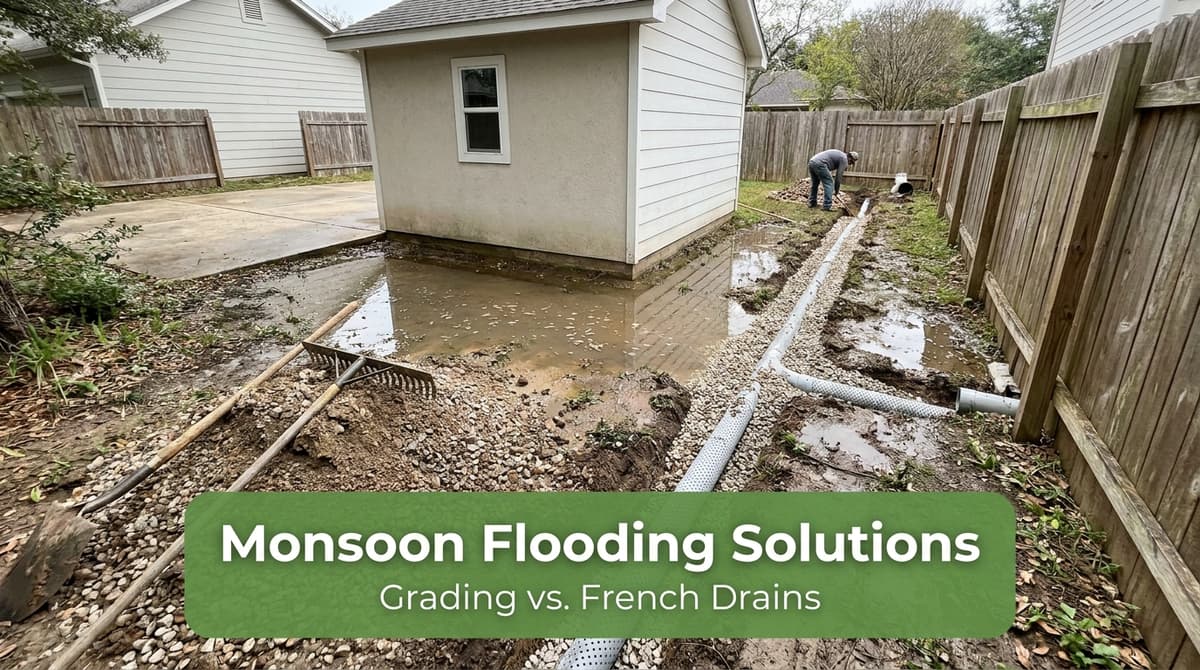
When Monsoon Water Rushes Your Casita Door
We recently got a call from a homeowner — let’s call him Mark — who lives out in the desert on a property with a 20' x 30' casita in the backyard. After a recent monsoon storm, Mark watched water pour straight toward the front door of his casita and actually into the building. Not just a little damp spot — real flooding.
Mark’s question was simple and very common: “Do I need grading? A French drain? Just a trench? And what’s this going to cost… am I about to get a $10,000 surprise?”
We walked him through the same process we use on every flooding call: figure out how the water wants to move, then choose the most cost-effective way to redirect it around the structure. If you’ve got a guest house, casita, or studio that takes on water during monsoon season, here’s how we think it through.
Start with the Cheapest Fix: Grading Around the Casita
On Mark’s call, we talked first about grading. In many cases, that’s the lowest-cost, highest-impact solution. Grading simply means reshaping the soil so water naturally flows away from the building instead of toward it.
For a small structure like a casita, we’re usually looking for at least a subtle slope dropping away from the foundation on all sides. When that slope isn’t there — or worse, is sloping inward — stormwater collects right at the door line or foundation and has nowhere to go except inside.
Why grading is often the best value:
- No expensive drainage materials required
- Less digging compared to deep French drains
- Improves overall site drainage, not just a single problem spot
- Usually lands in the “lower thousands” for more complex projects, not $10k+ for typical residential situations
When We Recommend French Drains or Trench Drains
Mark also asked about a French drain or simply digging a trench in front of the casita. Those can be good options, but we usually treat them as tools we use after we’ve addressed basic grading, or when grading alone isn’t possible.
French drains are gravel-filled trenches with perforated pipe that collect water and carry it to a safer discharge point. They’re great when:
- The building is already low and you can’t raise the grade easily
- Water is coming from a long slope above you (like a neighboring property)
- You have a narrow side yard where surface grading won’t move enough water
Simple surface trenches or swales — basically shallow, shaped ditches — can also work well. For a casita, we might cut a swale in front of the door area and curve it around the sides, guiding water to a safe outlet away from the structure.
These systems add pipe, gravel, fabric, and more labor, so they tend to cost more than a straightforward grading fix. That’s why, when Mark said “whichever one is cheaper,” we focused first on whether we could correct the grade.
How We Ballpark Costs Without Wasting Your Time
Mark was worried about sticker shock and asked us for a ballpark before we even scheduled a visit. That’s a fair concern. We never want to drive out just to hand someone a number that makes their jaw drop.
Here’s how we handle that in practice:
- We ask about the building size (like Mark’s 20' x 30' casita)
- We look at the address on satellite imagery to see slopes, access, and low areas
- We consider whether equipment can reach the casita or if it’s hand-work only
From there, we can usually give a rough range. For typical casita flooding issues, we often land in the low thousands, not five figures. The exact number depends on how much earth needs to move and whether we’re adding drainage hardware or just reworking the grade.
DIY or Call a Pro? A Quick Homeowner Checklist
Before you pick up a shovel or the phone, walk your property during or right after a rain (when it’s safe) and note the following:
- Where is the water starting? At a roof downspout, higher yard, driveway, or neighboring lot?
- Where does it want to go? Watch the natural flow lines in the dirt or gravel.
- Is the soil against the casita sloping in or out? A simple level or even a marble on a board can tell you.
- Do you have space to redirect water? Look for side yards or open areas where runoff can safely spread out.
If the problem looks minor and you’re comfortable with shovels and wheelbarrows, small adjustments might be DIY-friendly. But if you’re seeing repeated flooding at doors or walls, or if you’d need to dig deep trenches near foundations, it’s usually worth bringing in a crew that does this every day.
Common Mistakes We See with DIY Drainage
A lot of our work starts as “fixes for fixes” when a well-intentioned DIY project doesn’t behave the way the homeowner expected. Here are a few issues we run into regularly:
- Trenches that dead-end – Water collects in the trench but has no real outlet, so it just overflows back toward the building.
- French drains without slope – Perforated pipe must have consistent fall, or it simply becomes a buried bathtub that fills and sits.
- Raising grade against siding or stucco – Too much soil or gravel against a wall can create moisture and termite issues, even if it stops visible flooding.
- Sending water to a neighbor – Redirecting all your runoff onto the property line can lead to disputes and, in some areas, code problems.
The goal isn’t just to move water away from the casita; it’s to move it to a place where it can safely soak in or disperse without causing a new headache for you (or the person next door).
Protecting Your Guest House Before the Next Monsoon
If you’ve watched muddy water charge toward your casita door like Mark did, you don’t have to live with it. In many cases, a thoughtful grading plan and, if needed, a simple drain or swale can make a huge difference — without a five-figure price tag.
The sooner we see the site (ideally while monsoon patterns are fresh in your mind), the better we can design a solution that fits your property and your budget. Whether you’re leaning toward grading, a French drain, or you just need someone to look and give an honest opinion, we’re happy to walk you through the options.