How We Refresh and Re-Grade a Desert Gravel Driveway
Thinking about refreshing your gravel driveway? Here’s how we match existing rock, re-grade in the desert, and what to expect when a professional comes out.
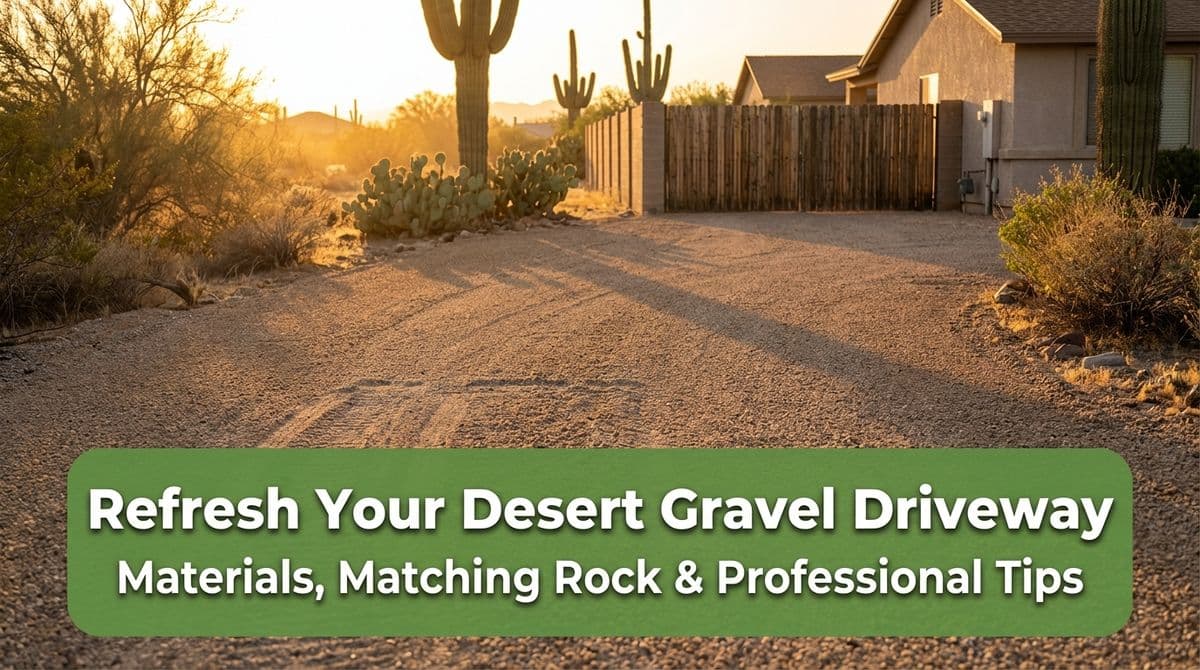
We recently got a call from a homeowner in Tucson…
We recently got a call from a homeowner — let’s call him Mark — who lives near the River and Campbell area here in Tucson. He works from home and had a gravel driveway that had seen better days. The rock had thinned out, low spots were collecting water when it rained, and the surface just looked tired and uneven.
Mark told us, “I’m not even sure what the material is — maybe crush and run? I just know it’s those rock pebbles that make up the driveway. I’d like to get it filled in and kind of manicured.” He also wondered if he needed to be home for the estimate and whether we’d be able to match the rock that’s already there.
Those are all really common questions, so I thought I’d walk you through how we handle a gravel driveway refresh and re-grade in the desert, the materials we use, how we match your existing rock, and what you can expect from a professional visit.
Do you need to be home for the estimate or service?
Like Mark, a lot of people work from home or have busy schedules and aren’t sure if they need to be present. Here’s how we typically handle it:
- Estimate visit: It’s nice if you’re home so we can walk the driveway with you and talk through trouble spots, but it’s not required. If you can’t be there, we can stop by, take measurements, photos, and then call or text you with questions.
- Service day: Again, you don’t usually need to be home as long as we have clear access. We’ll confirm details with you ahead of time so there are no surprises.
When Mark called, we did exactly what we usually do: got his location, checked how close he was to our current job, and offered to swing by later that afternoon. He texted us his information and a quick summary, and we handled the rest.
Materials: what’s actually on your driveway?
Many homeowners aren’t quite sure what’s on their driveway, and that’s okay. Around Tucson and other desert areas, we typically see a few common options:
- Crushed rock / crushed gravel: Angular rock that locks together well. Great for driveways because it doesn’t roll under your feet or tires as much.
- Pea-sized decorative rock: Rounded pebbles, usually 3/8" or so. Looks nice but can shift more than angular rock.
- Decomposed granite (DG) blends: Finer material that compacts into a firm surface when installed correctly.
When we visit, we’ll look at:
- Rock size (for example, 3/8", 1/2", or 3/4")
- Color and blend (tan, brown, pinkish, mixed, etc.)
- Existing depth and how much has migrated or compacted over time
From there, we can recommend whether you just need a top-off layer or a deeper refresh and re-grade, especially if the base has developed ruts and potholes.
How we match your existing rock
Mark’s biggest question was, “You’ll likely be able to match the rock that’s already on here, right?” That’s something we hear all the time.
Here’s the honest answer we give every customer:
- We almost always get very close on color and size. Local suppliers stock the common driveway materials for our area, and they usually have the same or a very similar product.
- There can be slight color variation over time. Rock we buy today is coming from the same quarry region, but not the exact same spot as rock that was mined 5–10 years ago. On top of that, your existing rock has aged in the sun, dust, and rain.
We like to set expectations this way:
- Short term: You may notice a slight contrast between the “old” and “new” rock for a little while.
- After some weathering: Sun, dust, and a bit of rain help blend everything together so the driveway looks uniform.
When we order material, we describe your existing rock to the supplier in specific terms — size, color name they use, and application (driveway traffic). If needed, we’ll also compare sample photos or take a small sample with us so we can get as close as possible.
What actually happens during a driveway refresh?
Every property is a little different, but a typical refresh and re-grade visit looks like this:
- Walk-through and problem check
We look for low spots where water collects, high spots that need cutting down, washouts from monsoon storms, and areas where the base has started to show. - Light grading and shaping
Using hand tools or equipment (depending on access and driveway size), we re-establish a gentle crown or slope so water sheds off the driveway instead of pooling or cutting channels. - Adding fresh rock
We spread new material evenly to the agreed depth, paying extra attention to thin spots and tire tracks. - Final shaping and cleanup
We fine-tune the grade, pull excess rock away from gate lines and garage thresholds, and tidy up edges so it looks clean, not just dumped.
For Mark, the plan was to even out the existing surface, top off with a closely matched rock, and restore a smooth, drivable surface that would stand up to traffic and the next round of desert storms.
How to prepare for a professional visit
If you’re thinking about having your driveway refreshed, here are a few simple things that make the visit go smoothly:
- Clear vehicles and obstacles from the driveway and any access points we’ll need.
- Let us know your priorities: For example, “This puddle here bothers me the most,” or “I want to make sure it’s easy to walk on for guests.”
- Share any history: If you know what was originally installed (name of the rock, thickness, or supplier), tell us — it helps with matching and planning.
- Decide your involvement level: If you can’t be home, we can coordinate by phone, text, and photos before and after.
When to call in a pro vs. DIY
You can certainly DIY small touch-ups, especially if you’re just raking a little rock back into place. But it’s worth calling in a professional when:
- The driveway has deep ruts, potholes, or drainage issues.
- You need several tons of rock and truck delivery and grading equipment.
- You want help choosing the right material and matching what you have.
If your desert gravel driveway is starting to look tired, you’re noticing puddles, or you just want it “filled in and manicured” like Mark described, a refresh and re-grade can make a big difference in both appearance and performance.
And if you’re not sure where to start, we’re always happy to come take a look, talk through options, and give you a clear plan before any rock is ordered.